• Home
  • Technical Information

Ricochet | Technical Information

Understanding Your Protective Gear

The science, testing, and standards behind firefighter PPE.

Your protective gear is designed to perform in demanding environments. Understanding how it's tested and evaluated can help you make informed decisions about protection, comfort, and mobility.

Explore the NFPA standards and performance measurements that help define firefighter PPE, including thermal protection, heat loss, and material performance.

Ricochet manufactures protective clothing in its ISO 9001-certified facility in Philadelphia, Pennsylvania.

NFPA Certification Requirements

NFPA standards establish minimum requirements for the design, performance, testing, and certification of firefighter protective equipment. Understanding these standards can help you identify gear designed for the hazards and demands of your role.

NFPA 1970

Structural & Proximity Firefighting

NFPA 1970 includes requirements for protective ensembles used in structural and proximity firefighting, along with other specified firefighter PPE. It establishes performance and testing requirements for thermal protection, durability, and other protective characteristics.

Explore NFPA 1970 →
NFPA 1950

Technical Rescue, EMS & Wildland

NFPA 1950 consolidates requirements for protective clothing and equipment used in technical rescue incidents, emergency medical operations, and wildland firefighting. Requirements vary according to the specific application and hazards.

Explore NFPA 1950 →

Each standard addresses specific hazards and performance requirements. Certification to one standard does not automatically establish suitability for another application. Always verify the certification and intended use of your protective equipment.

Understanding PPE Performance

Thermal Protective Performance (TPP)

TPP measures how well a protective clothing composite resists heat transfer under standardized laboratory conditions.

What Firefighters Should Know

  • Thermal protection: Higher TPP ratings indicate greater resistance to heat transfer under the specified test conditions.
  • Composite testing: TPP evaluates the combined performance of the outer shell, moisture barrier, and thermal liner.
  • Standardized testing: Test conditions are established before testing begins. No manual intervention occurs during the test.
  • Real-world performance: TPP is a laboratory measurement, not a prediction of safe exposure time during an actual fire.

Understanding the Number

TPP ÷ 2

Estimates the number of seconds to the modeled second-degree burn threshold under standardized test exposure.

Understanding PPE Performance

Total Heat Loss (THL)

THL measures how effectively a protective clothing composite allows heat to transfer outward under standardized laboratory conditions.

What Firefighters Should Know

  • Heat and moisture transfer: THL evaluates both dry heat transfer and evaporative heat transfer through the clothing composite.
  • Breathability: Higher THL values generally indicate greater potential for heat and moisture to escape under test conditions.
  • Composite performance: The outer shell, moisture barrier, and thermal liner all contribute to the result.
  • Heat stress: THL is one factor in managing heat buildup, but it does not independently predict a firefighter's risk of heat stress.

Understanding the Number

Higher THL = Greater Heat-Loss Potential

A higher laboratory THL rating indicates greater heat-transfer potential through the tested composite, not a guarantee of comfort or cooling on the fireground.

Understanding PPE Performance

Resistance to Evaporative Heat Transfer (RET)

RET measures how strongly a material or clothing composite resists the transfer of heat through moisture evaporation under standardized laboratory conditions.

What Firefighters Should Know

  • Moisture vapor movement: RET evaluates resistance to evaporative heat transfer through a material or composite.
  • Lower is better for evaporation: Lower RET values indicate less resistance to evaporative heat transfer under test conditions.
  • Material selection matters: Moisture barriers, liners, and other layers can influence RET.
  • Not a comfort guarantee: RET does not independently predict comfort, sweat evaporation, or heat stress during firefighting.

Understanding the Number

Lower RET = Less Resistance to Evaporation

Lower RET values indicate that moisture-related heat transfer encounters less resistance through the tested material or composite.

Understanding PPE Performance

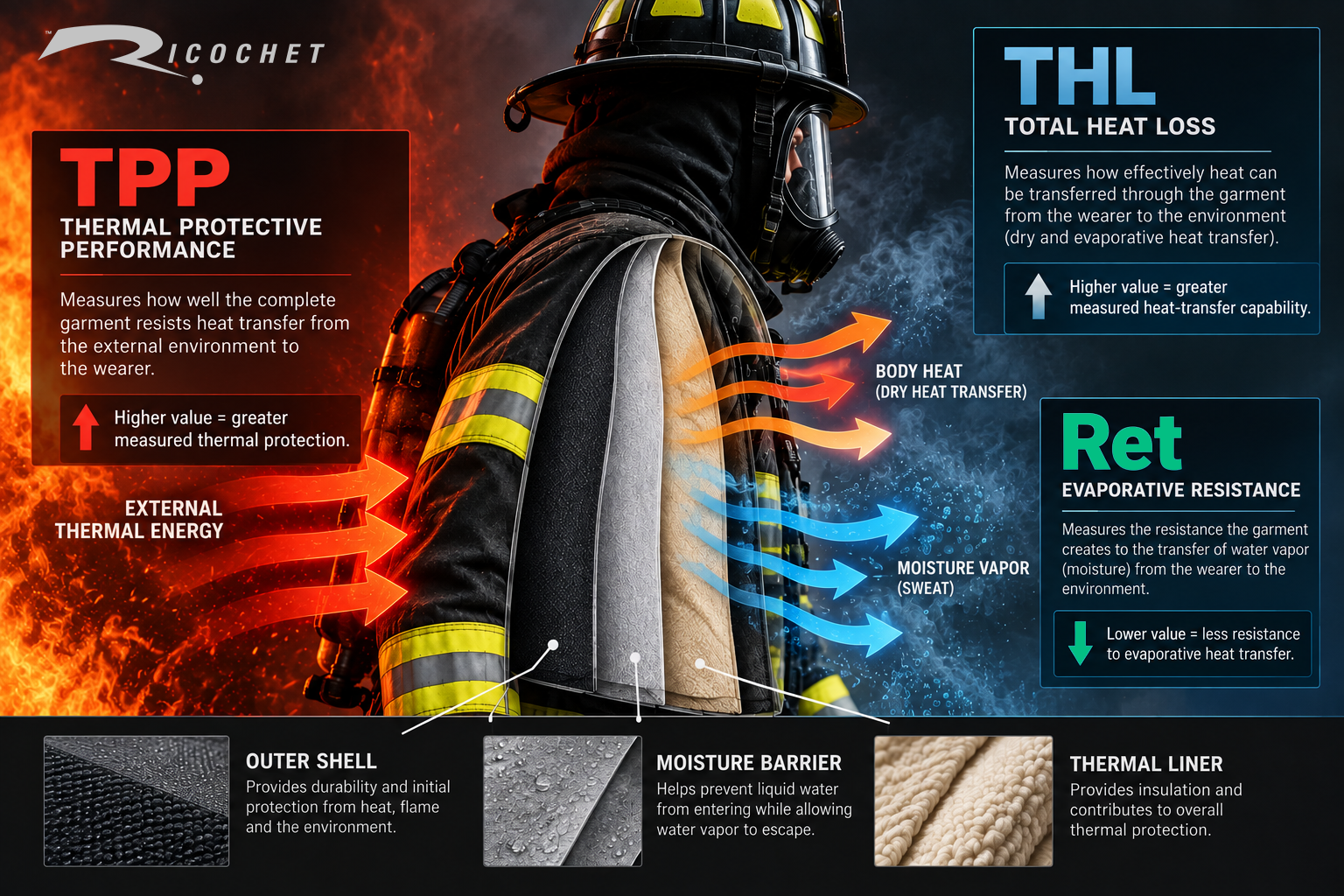
No single laboratory measurement tells the entire story. TPP, THL, and RET evaluate different characteristics of protective clothing. Understanding how they differ can help firefighters make more informed comparisons.

TPP

Thermal Protective Performance

Measures resistance to heat transfer through the protective clothing composite during standardized thermal exposure.

Higher TPP: Greater thermal protection under the specified test conditions.

THL

Total Heat Loss

Evaluates the potential for dry heat and evaporative heat transfer through the protective clothing composite.

Higher THL: Greater heat-loss potential under standardized test conditions.

RET

Resistance to Evaporative Heat Transfer

Measures resistance to evaporative heat transfer through a material or protective clothing composite.

Lower RET: Less resistance to evaporative heat transfer under test conditions.
Ricochet firefighter thermal protection infographic
Understanding the performance characteristics of firefighter protective clothing.

The Takeaway

Protective clothing must balance thermal protection with the ability to release heat and moisture. These measurements provide useful comparisons, but none independently predicts firefighter safety or comfort in actual fireground conditions.

Understanding PPE Performance

Conductive and Compressive Heat Resistance (CCHR)

CCHR evaluates how well protective clothing resists conductive heat transfer when pressure compresses its insulating layers.

What Firefighters Should Know

  • Compression reduces insulation: Kneeling or applying pressure to protective clothing can compress its insulating layers.
  • Contact heat matters: Heat can transfer through compressed protective clothing when it contacts a hot surface.
  • Critical areas: Knees and shoulders are particularly important areas for evaluating this type of protection.
  • Laboratory testing: CCHR evaluates resistance to conductive heat transfer under defined temperature and pressure conditions.

Key Takeaway

Compression Can Reduce Thermal Protection

CCHR helps evaluate protection in situations where insulating layers are compressed, but laboratory results do not establish safe contact times on the fireground.

Continue Learning

Understanding protective clothing performance is an important part of making informed PPE decisions. Explore these resources for additional technical information.

NFPA 1970

Explore requirements for structural and proximity firefighting protective equipment, including performance, testing, and certification.

View NFPA 1970 →

NFPA 1950

Learn about protective clothing and equipment requirements for technical rescue, emergency medical operations, and wildland firefighting.

View NFPA 1950 →

Ricochet Protective Clothing

Explore Ricochet's protective clothing solutions for structural firefighting, technical rescue, EMS, and wildland operations.

Explore Ricochet →